

Most planning starts in the same place. Somebody asks where the business is now, somebody else asks where it should be, and a whiteboard fills up with the distance between the two. It feels thorough. It usually produces a to-do list that looks sensible and changes surprisingly little.
The question that gets skipped is the uncomfortable one in the middle: if we carry on exactly as we are, where will we actually end up?
Three points and a gap
The model we use with business owners is, if we’re honest, three points of a triangle. We’d love to tell you it was cleverer than that. It isn’t, and that’s rather the point.
Diagnosis is where the business is today. Use a mix of data and narrative: the numbers, what’s working, what isn’t, and what it actually feels like to run the place on a Tuesday afternoon.
Prognosis is where the business is heading if nothing changes. Not where you’d like it to go, but where the current habits, workload and trends will take it by a set date. Think about money, time, effort and, yes, emotion.
Vision is where you want the business to be on that same date.
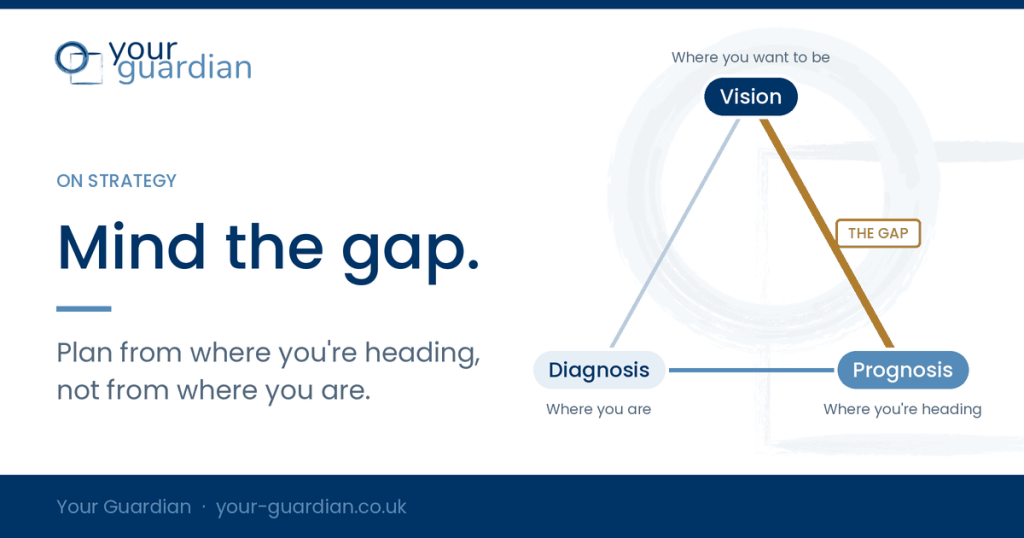
The strategic gap is the difference between the prognosis and the vision. Not between today and the vision. That single distinction changes most plans we see.
Why the prognosis matters so much
Businesses don’t stand still while you plan. Do nothing and things still move, usually in whatever direction they were already drifting. Measure your gap from today and you quietly assume the business will wait politely while you get organised. It won’t.
Take a pattern we see all the time. An owner has built a business that depends on them for almost everything: delivery, decisions, the admin nobody else knows how to do.
The diagnosis is clear enough. Everything routes through one person.
The prognosis is where it gets interesting. As the business wins more work, that dependence doesn’t stay level. It grows, because more work means more of it lands on the owner’s desk.
The vision is a business that can grow without needing more of the owner’s hours.
Measured from today, the gap looks like “hire someone to help”. Measured from the prognosis, it’s a different size and a different shape: rebuild how work flows, so the owner stops being the route everything has to pass through. Hiring might be part of that. On its own, it just gives the queue a second person to wait for.
Notice, too, that the vision decides the gap. If the owner’s real vision were simply to grow, and they were happy doing the extra hours, the gap would be a different one entirely. So be precise about what you actually want, not what you think you’re supposed to want.
Size the gap before you fill it
The most common trap is spotting a gap and deciding how to fill it in the same breath. A person you could hire, a system you could buy, a new service you could launch. Solutions are more fun than measurement, so they tend to arrive first.
The trouble is that a solution chosen before the gap is understood shapes the problem to fit itself. You end up recruiting for a job you haven’t described, or buying software to fix a process nobody has written down.
The action plan should be driven by the size and shape of the gap, not the other way round. If you regularly sit down on a Monday morning unsure what to work on, it’s rarely because you’re short of ideas. It’s usually because the gap has never been properly sized.
How to run it in an afternoon
You don’t need an away day for this. Two focused hours and a blank page will do.
- Pick a date. Twelve to eighteen months out is far enough to be meaningful and close enough to be honest.
- Write the diagnosis. Half numbers, half narrative. What do you like about the business right now? What don’t you? What’s working, and what isn’t?
- Write the prognosis, honestly. Assume nothing changes: same people, same habits, same approach. What does the business look like on your date? This is the step people rush, so don’t.
- Write the vision for the same date. Make it specific enough that you’d recognise it if you got there.
- Describe the gap. List what has to be true on that date that won’t be true if you carry on as you are. These are outcomes, not tasks.
- Only now, build the action plan. Every action should close a named part of the gap. If an action doesn’t close anything, it’s a hobby.
What usually comes out of it
Two things, in our experience. A few favourite projects fall off the list, because when you look at them honestly they don’t close any part of the gap. And the prognosis often reveals that the most important work is the least glamorous: writing down how things are done, defining roles before recruiting for them, and getting knowledge out of one person’s head and into something the whole team can use.
None of that makes for an exciting strategy document. It is, however, where the gap usually is.
Your next step
Block out two hours this month. Take one page and write three headings: Diagnosis, Prognosis, Vision. Fill them in that order, and spend the most time on the middle one.
If you’d like a second pair of eyes on the prognosis, which is the part most owners find hardest to be honest about, that’s exactly the kind of conversation we have with business owners every week.